If you’ve ever reviewed a commercial lease and wondered why the total monthly cost is higher than the base rent, you’ve likely encountered CAM. Common Area Maintenance (CAM) is one of the most important, and most misunderstood, components of commercial real estate leasing.
In our experience as brokers and advisors, CAM is not inherently good or bad. It’s a mechanism. When structured correctly, CAM gives owners clarity on what they will net at the end of the year and gives tenants transparency into what they are actually paying for. Problems arise when CAM isn’t clearly explained, properly capped, or fully understood upfront.
This guide breaks down what CAM is, how it works, how it’s calculated, and how it affects both landlords and tenants, so there are no surprises later.

What Does CAM Stand for in Commercial Real Estate?
CAM stands for Common Area Maintenance. In commercial real estate, CAM refers to the operating costs associated with maintaining and managing shared areas of a property that all tenants benefit from.
When Is CAM Relevant?
CAM becomes relevant any time a property has multiple tenants, shared spaces, and operating costs beyond a single tenant’s premises.
- Multi-tenant buildings
- Retail centers
- Office buildings
- Industrial parks with shared infrastructure
You’ll encounter CAM most often where parking lots, hallways, lighting, landscaping, or shared amenities exist.
Understanding the Types of Commercial Leases and How CAM Applies
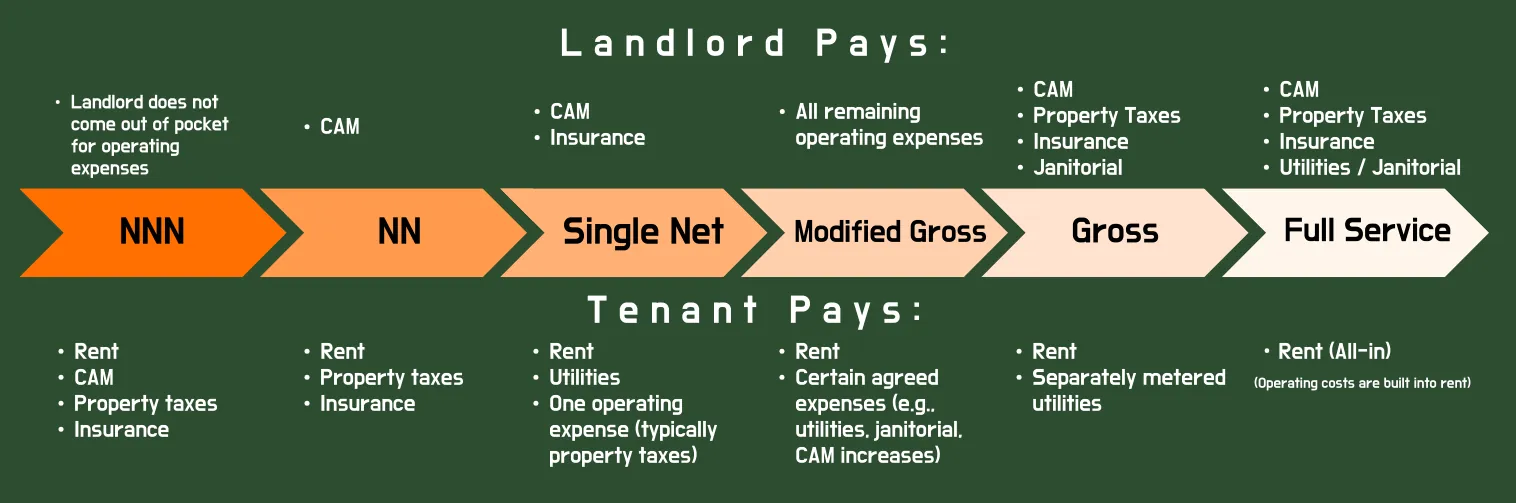
Think of commercial leases as a spectrum. On one end, the owner pays almost everything. On the other, the tenant does.
Full-Service Lease
A form of gross lease where utilities and janitorial services are often included. Predictable for tenants, but higher risk for owners.
Gross Lease
The landlord pays CAM, taxes, and insurance. Tenants pay a flat rent with minimal variability.
Modified Gross Lease
CAM and operating expenses are shared through base-year structures or negotiated expense stops. Common in office leases.
Net Lease
The tenant pays one operating expense (typically taxes), while the landlord pays CAM and insurance.
Net Net (NN) Lease
Tenants pay property taxes and insurance while the landlord covers CAM. These are less common and often come with higher base rent.
Triple Net (NNN) Lease
The most common “net” structure in retail, office and many industrial deals. The tenant pays their share of:
- CAM (common area maintenance)
- Property taxes
- Insurance
This is the lease type where CAM is most explicitly separated and visible, which is why tenants need to understand CAM from day one—not just base rent.
Practical Takeaway
Full-service leases protect tenants from operating cost volatility, while NNN leases protect owners from rising expenses. Most leases fall somewhere in between.
What Is CAM in Commercial Real Estate and How Does It Affect Your Lease?
CAM directly affects your true occupancy cost. Two spaces with the same base rent can have dramatically different total costs depending on how CAM is structured.
This is why focusing only on base rent is misleading. We always walk clients through base rent, CAM, taxes, and insurance before decisions are made.

What Is Included in CAM Charges?
- Parking lot maintenance
- Snow removal
- Landscaping
- Property management fees
- Common area utilities
- Janitorial services
- Interior hallways and common areas
- Shared bathrooms
- Elevator maintenance
- Exterior lighting
Other CAM Expenses to Watch For
- Security systems and monitoring
- Fire and life safety systems
- Trash removal
How Is CAM Calculated in Commercial Real Estate?
CAM is typically billed monthly based on an estimate, then reconciled annually against actual expenses.
Understanding Load Factor and CAM
Load factor converts usable square footage into rentable square footage by allocating common areas proportionally. This is common in office buildings and effectively embeds CAM into rent.
Fixed vs. Variable CAM Costs
- Fixed CAM: Predictable, often with annual escalations
- Variable CAM: Based on actual expenses and reconciled annually
Capped CAM Charges
When representing tenants, we typically push for annual CAM caps in the 4–6% range. Caps protect tenants from budget shocks while still allowing owners to recover reasonable cost increases.
CAM Reconciliation and Why It Matters
CAM is billed as an estimate throughout the year. At year-end, landlords reconcile estimated CAM against actual expenses.
Tenants may receive a refund or owe additional rent. Annual CAM audits protect both parties and prevent disputes rooted in misunderstanding rather than misconduct.
CAM in Commercial Real Estate: Frequently Asked Questions
Are CAM Charges Negotiable?
Yes. Scope, caps, audit rights, and exclusions are all negotiable.
How Much Should CAM Fees Be?
There is no universal benchmark. CAM varies by asset class, market, building age, and amenities.
Are CAM Fees Considered Income for Landlords?
No. CAM is a reimbursement for operating expenses, not profit.
Final Thoughts: Why CAM Clarity Matters
CAM isn’t about shifting risk unfairly. It’s about clarity, transparency, and alignment.
When owners understand CAM, they protect long-term returns. When tenants understand CAM, they budget accurately and avoid surprises.
In our experience, most CAM disputes come from misunderstanding, not misconduct.
Need Help Reviewing a CAM Clause?
Whether you’re structuring leases or evaluating total occupancy cost, a second set of eyes can make all the difference.
Review My Lease